Newsletter Subscribe
Enter your email address below and subscribe to our newsletter
Enter your email address below and subscribe to our newsletter

 ByJohn A
If a fitting of the required diameter is already known, choosing a fitting might appear to be easy. But connecting pipes by matching only the size of fittings is just one aspect. Fittings looking identical can sometimes adopt unrelated threading standards despite sharing common nominal sizing!
The pitch, taper, thread type & threading form determine successful and precise connection; forcing two incompatible parts into one can often compromise functionality by resulting in damaged fittings or ineffectual unions; more pertinently, it compromises in tough working settings involving high temperature and pressure in pipelines, especially in industrial settings. So, the need to understand the thread size of already connected apparatus and also select based on these specifications even before seeking pipe fittings manufacturers in India is crucial to ensure suitability and prevent leakage.
Don’t order in mistakes. Many users make the mistake of thinking two pipes of the same rated size will connect automatically. Nominal pipe sizes (NPS and NB) are good information to have; however, NPS alone will not identify the thread form. Since each thread series has unique angles, pitches and profiles of the teeth, they could vary even if the NPS is the same.
For instance, an NPT connection, despite having a similar nominal size, is a completely different type of connection than the BSP; a so-called 1/2 inch connector is simply not interchangeable. The connection type needs to be specified before ordering the fitting.
See also: Locksmith Services: Benefits of Hiring a Qualified Expert
NPT is an acronym for National Pipe Taper and is one of the most popular thread types in piping and fluid-system applications. From its acronym name, it should be obvious what defines this style of threaded connection: they are tapered. That is, the diameter of the thread decreases along its length, enabling the mating (male and female) parts of the system to be snugged tight.
Typically, NPT connections require the use of a suitable thread sealant in order to create an effective seal. Consult the appropriate system and component manufacturer recommendations for the specific sealing method you should use.
One critically important note you’ll see in our comparison below: when selecting components, it’s crucial to understand that NPT indicates far more than just the name of the system; it is a specific thread form that should connect to exactly what you intend to!
BSPP or parallel pipe thread, and BSP T or taper pipe thread. This difference is key because the way a parallel or tapered fitting is sealed varies. BSP & NPT: Sometimes BSP or NPT threading can resemble the other in general appearance (especially on smaller-size fittings), but the thread shape is actually totally different.
A Fitting should never be assumed compatible just because the threading appears to “mesh” when trying to tighten together. Always confirm the thread standard to make sure there’s no guesswork.
Identifying whether a thread is parallel or tapered is a key step in selecting the right fitting. A tapered thread has varying diameter along its length. Drawing threads tightly forces the mating parts deeper together.
A parallel thread has a constant diameter. Whether or not it seals will, depending on the specific connection arrangement, come from something more than the interference created by the threads. These two basic differences directly impact installation and sealing techniques.
A mechanic replacing a broken fitting will need to ascertain whether the port is equipped with a tapered thread or a straight-thread component before ordering a replacement. Just getting the nominal size right will not be sufficient – it’s critical to match the thread form, too.
SAE-standard straight threads and MS threads are also commonly found in some industrial systems.
Unlike tapered pipe threads, the design and structure of straight threads differ. In numerous arrangements of straight-thread connectors, the threads are used only for the mechanical connection; actual sealing is performed by a dedicated O-ring or other surface. This emphasizes the value of understanding different thread forms.
While two male fittings might have the same nominal threaded diameter, the way a connection made with them is intended to seal could differ tremendously. Installing a component with a particular sealing approach in a port designed for another will produce a mismatched connection. Understanding thread compatibility is a two-part equation.
Thread standard is only a small part of the connection description. The buyer still needs to specify whether the fitting end they want is male or female.
A male thread is located on the outside of the fitting, while a female thread is inside. Many fittings can be adapted to use a combination of connection types.
Adapters, for example, may offer a transition between male and female threads or between different thread standards. Elbows, tees, couplings, reducers and other designs can also incorporate a range of combinations.
A purchase order for a fitting that clearly defines both ends can be made without confusion. Instead of requesting just a given size, a buyer should also identify the size, thread standard and male or female definition of the connection.
Thread pitch is the distance from one thread to the next. Different standards may have different pitch specifications even if the diameter of the fitting is the same. Again, this is another reason why looking at two fittings together is not reliable.
If the pitch does not match, the threads will not mesh properly along the full length of the port. Forcing them together will result in damage to one or both fittings. Existing fittings can be identified with thread gauges and numbers specified in technical data.
It is better to find a thread gauge or specification for a critical port fitting and measure the new fitting rather than trying to shove a new fitting into a port to see if it will fit!
A suitable fitting should tighten readily to make a proper connection without excessive force due to thread interference.
If two incompatible threads are tightened together, it can mar the thread surfaces which could render the fitting useless and damage the port of a more costly valve, instrument or piece of equipment.
The connection may tighten up but still not achieve the proper seal.
This is highly undesirable, especially in pressurized systems, where the integrity of the connection is vital to safe and reliable functioning.
It is important that, when a fitting does not engage as desired, the correct specifications are checked rather than continually tightening it and hoping that the connection will be successful.
Sometimes industrial systems contain equipment designed around different standards. Simply updating everything to use the same threads could prove difficult.
Adapters can allow a transition between compatible but different connection standards.
An adapter could, for example, connect a thread standard on one side to a different type of connection on the other. Any components relying on a different standard could then be integrated into a system if such an adapter with the required specifications exists.
However, as with any component, an adapter needs to be chosen depending on the operating conditions. Standard configuration is one factor but material, pressure, temperature and media compatibility are also important.
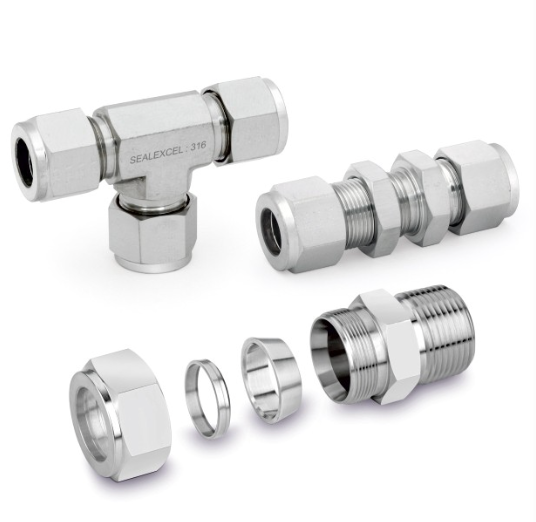
Just because the thread is right doesn’t mean that the fitting is going to work well in this situation. Industrial precision pipe fittings may be capable of supporting high-stress applications with pressures up to several thousand PSIG depending on their configuration and function. The actual capabilities can fluctuate significantly based on the component configuration, fitting type and system condition, though.
Fortunately, to ensure your solution will meet performance specifications, you just need a pressure fitting rated at a certain pressure. The same is applicable if you use an adapter to correct a threaded connection mismatch – don’t forget to review the system’s highest potential internal pressure, taking into account the pressure rating of the fittings. When it’s time to create your plumbing assembly, look for your high-pressure fitting as a unified system – don’t forget to consider more than just the fitting in the high-pressure line to your application.
Temperature can also be considered a critical specification when examining thread compatibility. While stainless steel precision fittings are adaptable for reasonably high operating temperature scenarios, maximum usable range is governed by such variables as the specific fitting or seal and by the overall system in use. A fitting may feature compatible NPT, BSP or straight-threaded connections but still be incapable of withstanding operating temperatures at the operating end of the range, or anywhere even nearing that end.
The fitting, in other words, might have a usable connection to assemble with other components; this is the first hurdle for complete application suitability. Media compatibility, pressure ratings, and operational temperatures-in addition to materials, still remain additional questions to be asked and answered.
Material selection is particularly important when fittings are used with chemicals, gases or fluids that may interact with system components.
SS316 stainless steel is commonly used for precision pipe fittings because of its mechanical properties and corrosion resistance across many industrial environments. However, material suitability should still be assessed according to the actual medium and operating conditions.
Buyers should also consider the materials of the surrounding pipe, tubing, valves and equipment.
When contacting pipe fittings manufacturers in India, providing information about the intended service conditions can make it easier to identify fittings that meet both connection and material requirements.
One of the easiest ways to avoid thread compatibility problems is to identify existing ports before ordering new components.
Equipment documentation may specify the required thread directly. Where documentation is unavailable, the existing fitting can be examined and measured using appropriate tools.
Useful information can include nominal size, outside diameter, thread pitch, whether the thread is tapered or parallel, and whether the connection is male or female.
Photographs alone may not always be enough to distinguish similar thread standards accurately.
Taking measurements beforehand can prevent delays caused by receiving a fitting that looks correct but cannot be properly installed.
Technical drawings and dimensional information are particularly valuable when fittings need to fit into compact or precisely designed systems.
A fitting may have the correct threads but still differ in overall length, hex dimensions or configuration. These differences can affect installation where space is limited.
Reviewing dimensions also helps when replacing an existing elbow, tee, adapter or coupling.
For more complex assemblies, creating a clear list of connection requirements before ordering can be useful. Each fitting can then be checked for thread type, size, orientation and physical dimensions instead of relying on a general description.
Clear specifications make sourcing easier.
When requesting a fitting, buyers should ideally provide the fitting type, nominal size, thread standard, male or female configuration, material and relevant operating conditions. Pressure and temperature requirements should be included where appropriate.
For adapters, both connection ends should be described separately.
Providing this information when comparing pipe fittings manufacturers in India reduces ambiguity and makes it easier to determine whether a particular fitting matches the intended system.
It also helps avoid substitutions based solely on approximate size or appearance.
Thread compatibility is a fundamental part of selecting pipe fittings, but it involves considerably more than matching nominal sizes. NPT, BSP parallel, BSP tapered and SAE/MS straight threads have different geometries and can use different sealing methods. Male and female configurations, thread pitch and physical fitting dimensions also need to match the intended connection.
Forcing incompatible threads together can damage components and may fail to create the required seal. Adapters can provide transitions between different connection standards, but they must still meet the pressure, temperature and material requirements of the application.
Before contacting pipe fittings manufacturers in India, buyers should identify the existing connection as completely as possible. Checking the thread standard, size, configuration and operating conditions before ordering is far more reliable than discovering a mismatch during installation.