Newsletter Subscribe
Enter your email address below and subscribe to our newsletter
Enter your email address below and subscribe to our newsletter

 ByJohn A
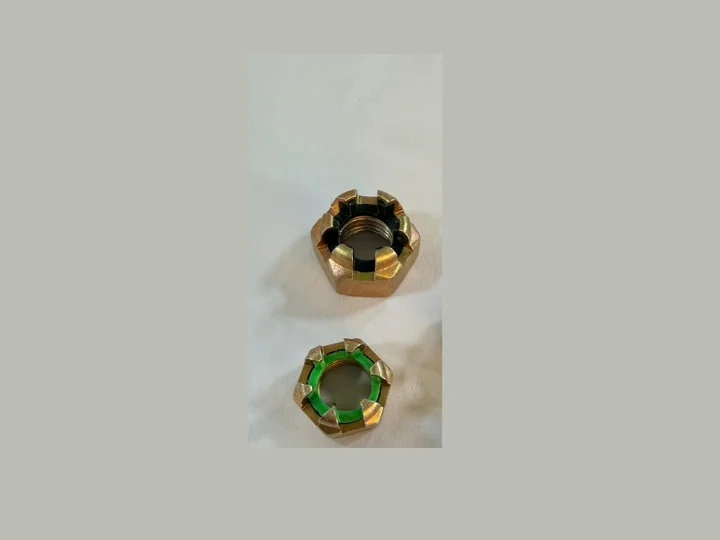
Every mechanic who has worked with castle nuts has hit this moment. The joint is torqued correctly, the wrench feels right, and then you look down and see the cotter pin hole sitting stubbornly between two slots. Not close. Just off. You are stuck holding a decision about a decision that most torque specifications never bother to address, and the clock is running. What happens next decides whether that joint survives its service life or quietly starts working loose a few thousand cycles from now.
This is the half-flat problem, and it catches out more experienced people than anyone likes to admit. Castle nuts have six flats and typically six slots, which means each flat represents roughly 60 degrees of rotation. Land halfway between and you have about 30 degrees of correction to make, in one direction or the other. Neither option is free.
The gap between the specified torque and the nearest slot is not a manufacturing defect. It is tolerance stack-up doing exactly what tolerance stack-up does.
Consider what is stacking:
Add all of that up and slot alignment at target torque becomes something close to luck. One joint in six will land clean. The rest need a decision.
See also: How Pneumatic Hose and Fittings Affect Airflow, Pressure and Equipment Performance
Here is where joints get quietly damaged.
The first wrong answer is tightening onward until a slot appears. It feels safe. Tighter is stronger, or so the thinking goes. In practice, you may have just pushed the fastener past its intended clamp load, into the region where the bolt starts yielding. On a tapered joint like a steering knuckle or a wheel bearing, that extra 30 degrees can add far more preload than the number on the wrench suggests, because taper geometry amplifies small rotations into large axial movement.
The second incorrect answer is to back off until a slot appears. Also feels reasonable. You have stayed under the maximum, after all. But now the clamp load might be below the minimum required to prevent the joint faces from separating under load reversal. The pin will hold the nut. It will not hold the joint together. Fretting starts at the mating faces, then wear, then movement, then a failure that looks like the pin failed when it never had a chance.
Both approaches share the same flaw. They treat the slot as the target and the torque as flexible. It is the other way around.
Most castle nut specifications give a minimum torque and a maximum torque. That range exists for exactly this reason. The correct move is to torque to the minimum first, then advance toward the maximum until a slot aligns with the cross-hole.
If a slot appears anywhere inside that window, you are finished. That is the answer the specification anticipated.
If nothing lines up before you reach the maximum, stop. Do not push past it. That is the point where the joint is telling you something is wrong with the stack, not with your technique.
Some specifications, particularly in aerospace hardware such as MS17825 and MS17826 castellated nuts, are written with tighter control precisely so this situation is rarer. Others, especially on older automotive designs, leave you far more room and far more guesswork.
When the window closes without alignment, you still have options that don’t involve fudging the torque.
The washer swap solves most of these in the field. It is unglamorous, and it works.
If the same joint fights you every single time across multiple units, the assembly is not the issue. Cross-hole placement on the bolt was probably specified without accounting for the full tolerance chain. That is a drawing problem, and it belongs back with whoever produced the drawing.
Manufacturers who control both the nut geometry and the thread quality closely give you fewer of these fights. A consistent thread start position and tight dimensional control of slot depth and spacing narrow the odds considerably. Materials matter too. A286 stainless and 4130 alloy castle nuts made to aerospace dimensional standards behave far more predictably than commodity parts of uncertain origin.
Before your next castellated assembly, write down three numbers: minimum torque, maximum torque, and the washer thickness you are using. Torque to minimum. Advance to alignment. If the window closes with nothing lined up, change the washer rather than the torque.
That single habit prevents the two failure paths that half-flat guessing creates. And it stops you from finding out about them later, on a joint that has already been in service.