
A tender response can look completely long before anyone tests the answers sitting behind it. The price lines add up, the delivery dates look tidy, and the photos match the brief. Problems tend to appear later, once a chair arrives in the wrong colour or a replacement motor proves hard to source. Asking a hospital furniture supplier in Australia the right questions before you sign costs nothing, and it spares your team a lot of awkward follow-up after delivery.
These decisions come up often. The Australian Institute of Health and Welfare counted 704 public hospitals with 67,300 available beds in 2023-24. It also lists 633 private hospitals as of September 2025. The Productivity Commission reports that more than half of public hospital stays that year were same-day. Many of those patients spend their treatment in a chair or on a table, which puts seating near the top of the list. So which questions should you ask a hospital furniture supplier for Australia first?
Who Manufactures the Hospital Furniture, and Where Is It Made?
Here is why this question comes first. An importer can quote quickly, yet it may not control the frame, the motors or the upholstery. Once you ask for a change, the request travels back up a chain you never see.
Esthetica Medical Furniture makes its whole catalogue at one plant in IMT Manesar, near Delhi, and has built treatment furniture since 2011. CNC turning, laser cutting, welding, powder coating and upholstery all happen on site. That setup lets the factory handle a custom colour or an altered dimension as an ordinary production job.
Buying direct also removes the importer’s margin from the quote. Some teams still prefer a local distributor they already know, and that comfort may be worth something. It is worth less than it first seems, though, once the spare parts question comes up.
Can the Supplier Share Spec Sheets for Every Chair and Table?
A brochure says what a chair can do. A spec sheet shows how, and it gives your evaluation panel something concrete to compare. Ask for one per model before shortlisting anyone.
Let’s break it down, starting with seating. Esthetica’s treatment chair for day oncology and infusion uses a separate motor for each of five movements: backrest, leg rest, height, tilt and footrest. The handset stores preferred positions so nurses can quickly reset a bay between patients. Its dialysis chair adds a quick-release backrest for CPR.
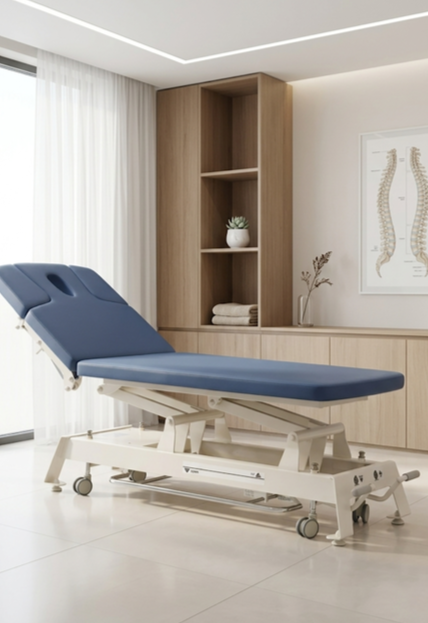
Tables deserve the same scrutiny. The Parth Physiotherapy Table and the Mahit 7-Section Treatment Table both use a walk-free switch along the base, so clinicians can adjust height without hunting for a pendant. Two- and three-section examination tables run on an electric actuator and lower far enough for older patients to sit without help.
Questions worth putting on paper:
- How many motors does each chair use, and which movement does each one control?
- Can the handset store preset positions, and how many?
- Is Trendelenburg positioning available on the exact model in your quote?
- Which upholstery does the chair use, and will it tolerate the disinfectants your infection control team already buys?
Will Upholstery, Motors and Spare Parts Match Across Every Room?
Mixed suppliers often mean mixed parts. A few years after handover, a maintenance team may find itself stocking four types of actuator for one floor. That is a quiet cost, and it rarely shows up in the tender price.
Esthetica produces its tables and chairs on the same lines, so upholstery colour and actuator type stay consistent through a fit-out. Replacement motors and upholstery panels come from the line that built the original unit. The covers resist abrasion and disinfectants, which matters when a surface gets wiped down several times a day.
Of course, full uniformity isn’t always the goal. A paediatric area may want a warmer colour than an oncology unit, and the factory can match colours to an interior scheme before production starts. Which matters more to your hospital, one look everywhere or a finish chosen for each space?
See also: Custom Business Signs: How They Create a Strong Business Identity
How Will the Hospital Furniture Order Reach Australia?
Freight is where many quotes lose their accuracy. Esthetica ships from Delhi NCR by sea or air, creating every unit for container transit and load-testing it before packing. Finished units reach Sydney, Melbourne, Brisbane and Perth on a single export invoice.
The export team prepares the packing lists, invoices and shipping documents at its end. Lead times depend on the model and the volume, so get dates in writing. A landed cost estimate matters too, since an ex-works figure leaves freight out of the comparison. Buyers in Perth, for example, will want to check transit time against their opening date before anyone else does.
Next Steps Before You Sign the Tender
The next steps are practical. List the chairs and tables you need for each room, note any colour requirements and mark your delivery window. Then send that list through Esthetica’s enquiry form.
Esthetica returns Australian landed cost estimates within two working days. Clear written answers at this stage shorten the evaluation meeting, and they leave far less to dispute once the crates arrive.